







Deve un neonato fare sempre il ruttino?
No, a baby does not have to make a audible burp after every meal. Some babies swallow very little air while drinking and seem content even without burping. If your baby shows restlessness, pulls their legs up, arches their body, or drinks very hurriedly, a short break in an upright position may help. A few minutes of gentle rubbing or patting are usually enough; if no burp comes and your baby is relaxed, you do not need to force it.
Why babies burp in the first place
While breastfeeding or drinking from a bottle, air can be swallowed. This air collects in the stomach and can cause pressure. When burping, it escapes through the esophagus. How much air a baby swallows depends, among other things, on their drinking technique, the breastfeeding or bottle position, the teat, the milk flow, and how calm or hungry they are at the time.
According to the American Academy of Pediatrics, bottle-fed babies swallow air more frequently on average than breastfed babies. However, this is not a fixed rule: A breastfed baby can also drink hurriedly, and a bottle-fed baby can suck very calmly. Your child's signals are what matter.
The quick decision guide
| Situation | What you can try | When you do not need to keep trying |
|---|---|---|
| Baby drinks calmly and seems content | Hold upright briefly after drinking | If they remain relaxed and no burp comes |
| Baby becomes restless while drinking | Pause feeding briefly, change position, gently rub their back | If they calm down and want to continue drinking |
| Baby spits up small amounts more often | Feed more calmly, use natural breaks, carry upright afterwards | If they are cheerful, drink well, and gain weight |
| Baby falls asleep after drinking | Only gently raise them if it is easy | If they sleep peacefully; always lay them flat on their back to sleep |
When is burping particularly useful?
A short attempt is especially advisable if your baby smacks their lips, sucks hurriedly, turns away, cries suddenly, arches their back, or pulls their legs up. A short break after switching breasts or during a natural pause while bottle-feeding can also be comfortable in an upright position.
You do not need to interrupt a meal according to a rigid minute-by-minute or volume-based plan. The NHS recommends paying attention to your baby's signals: If they seem uncomfortable while drinking, a break may help; if they drink calmly, they can continue drinking for now. Especially in the first few weeks, this flexible approach is often more practical than a fixed routine.
Three safe positions for burping
1. Upright on the shoulder
Place a burp cloth over your shoulder. Hold your baby high enough so their chin rests comfortably. Support their head, neck, and upper back with one hand, and gently rub or pat their back with the other. Keep their body upright without compressing their tummy.
2. Sitting on the lap
Sit your baby on your lap sideways or with their back to you. Support their chest, chin, and jaw with one hand; do not apply pressure to their neck. Lean their upper body slightly forward and slowly stroke their back with your free hand.
3. Lying face down across the lap
Lay your baby face down across your thighs. Support their head and chin, and make sure their head is slightly higher than their chest. Gently rub or pat their back. This position is only suitable as long as you hold and observe your baby continuously; it is not a sleeping position.
How long should you wait for a burp?
A few minutes are usually enough. The NHS explicitly states that parents do not need to spend a long time burping their baby. If no burp comes and your baby seems content, you can continue the meal or let them rest. Even a very quiet burp can easily be missed.
If your baby remains restless, try changing position once. If that also does not help, check other obvious causes: Is their diaper full, are they too warm, do they need closeness, or do they want to continue drinking? Not every restlessness after a meal is caused by air in the tummy.
Spitting up and burping: What else is normal?
Small amounts of milk coming back up during or shortly after burping are common in infancy. The sphincter muscle between the stomach and esophagus is not yet fully developed. As long as your baby seems content, drinks well, and gains weight, occasional spitting up is usually not a cause for concern.
Burping can reduce spitting up, but it does not reliably prevent it. Hold your baby upright for a while after drinking and avoid applying strong pressure to their tummy. For sleep, however, still lay your baby on a firm, flat surface on their back. The mattress should not be raised – not even for reflux. You can find more about preparing calmly in the guide First Night at Home with Baby.
When should you seek medical advice?
Contact your midwife, pediatrician, or family doctor promptly if your baby seems to be in pain frequently, refuses meals, does not gain weight as expected, or if you are unsure. According to the NHS, you should particularly have the following checked: green or yellow vomit, blood in the vomit or stool, projectile vomiting, a swollen or tender tummy, persistent refusal to drink, clear signs of dehydration, or if the baby cannot keep any fluid down.
This guide provides orientation, but does not replace an individual assessment. For very young babies, it is better to seek medical advice one more time.
Practical textiles for meals and burping
A burp bib protects the neck and chest area during and after a meal. A larger muslin or muslin cloth is practical over the shoulder, on the lap, or as a base. It should never cover the face and should not lie loose in the sleeping area. Which size is right for which everyday situation can be found in the separate Muslin Cloth Size Comparison.
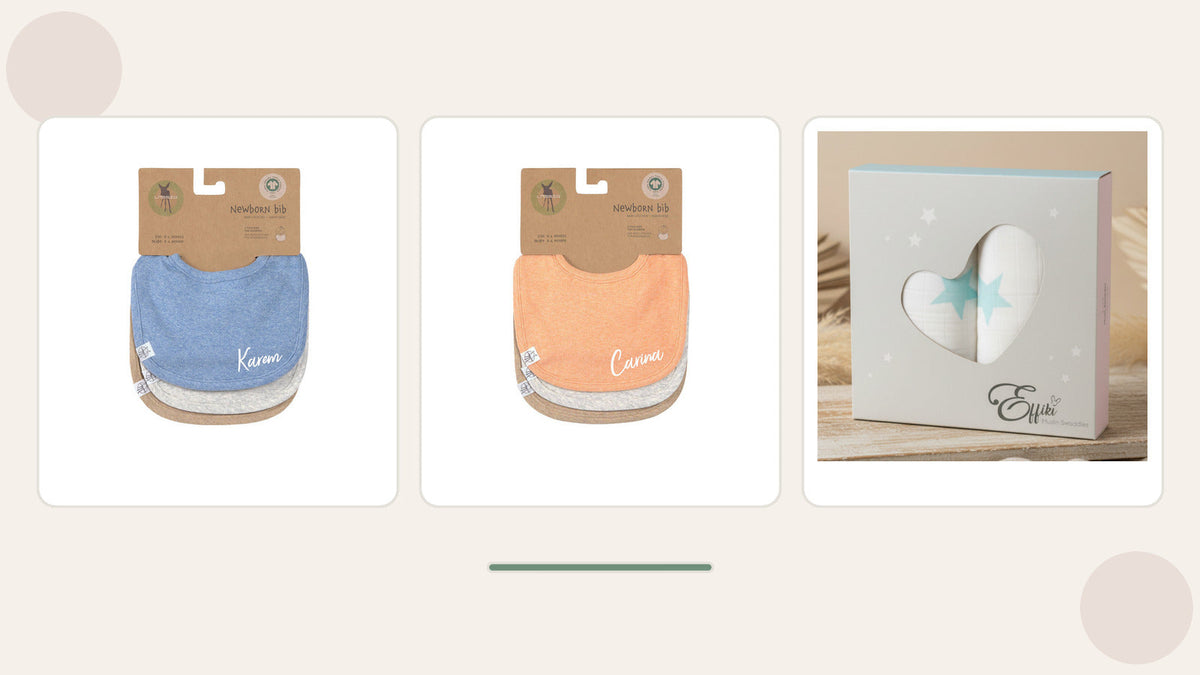
 Lässig burp bib Blue/Grey/BeigeThree small everyday cloths; available with or without personalization.
 Lässig burp bib Apricot/Grey/BeigeSet of three for regular changes; personalization optional.
 Trixie Bandana bib Cocoon CaramelTwo bandanas for the neck area; with or without a name.
 Effiki muslin cloth set of 2 115 × 115 cmLarge format for the shoulder or as a base; personalization possible.
 Lässig Little Water Whale 80 × 80 cmHandy set of three for the shoulder, lap, and on the go.
 Lässig Tiny Smile Beige 85 × 85 cmNeutral set of three for everyday use.
Typical mistakes surrounding burping
- Waiting too long: If your baby is relaxed, patting for minutes does not provide any additional benefit.
- Patting too hard: Gentle stroking or rubbing is often enough.
- Putting pressure on the neck: Support the chin and jaw, but never press on the throat.
- Confusing spitting up with dangerous vomiting: Small amounts are common; warning signs such as green color, blood, or projectile vomiting must be checked.
- Unsafe sleeping position: Even after spitting up, a baby should sleep flat on their back, not on their side or on a raised mattress.
Conclusion: The absence of a burp is not automatically a problem
A burp can release trapped air, but it is not a mandatory routine after every meal. A short, calm break and a well-supported upright position are usually enough. If your baby seems content, drinks well, and develops normally, you can meet the missing sound with equanimity. In case of pain, drinking problems, noticeable vomiting, or lack of weight gain, professional advice is more important than further home remedies.
Frequently Asked Questions
Does a breastfed baby have to burp?
Not necessarily. Some breastfed babies swallow very little air. If your baby is relaxed after breastfeeding, you do not need to force a burp.
Does a bottle-fed baby always have to burp?
The same applies to bottle-feeding: Some babies need support, others do not. A suitable teat size, a calm drinking position, and natural breaks can help reduce unnecessary air swallowing.
What to do if no burp comes?
Try another well-supported position for a few minutes. If your baby remains calm, you can stop. If restlessness persists, a midwife or pediatrician can look at the feeding situation with you.
Can my baby sleep immediately after drinking?
If they are calm, they can sleep. Lay them on a firm, flat sleeping surface on their back. Loose cloths do not belong in the baby crib.
Why does my baby spit up when burping?
Some milk can come back up when the air escapes. This is common in infancy. Noticeable color, blood, projectile vomiting, pain, or drinking problems should be assessed by a doctor.
Does a burp bib help with reflux?
No. It protects clothing and the skin area from moisture, but does not treat any cause. For distressing or noticeable symptoms, medical advice is necessary.
