







Which wooden play kitchen is right for your child?
Direct answer: A wooden play kitchen is a good fit when its age recommendation, footprint, working height, and features suit your child and your home. For small spaces, a compact model with included accessories is practical. If you want to expand it over the long term, pay attention to storage space, sturdy doors, and separate play food accessories. Personalization is especially nice as a gift, but it should never replace a comparison of dimensions, delivery contents, and safety instructions.
Play kitchens often look similar in product photos. In everyday use, however, they differ significantly: Some models are low and compact, others taller or wider; some come with pots and textiles, while others offer plenty of storage space. Therefore, the most important question is not “Which kitchen is the prettiest?”, but: Which wooden play kitchen suits our child, our space, and the way we play?
This guide helps you with exactly this purchasing decision. It compares three currently available models, explains sensible selection criteria, and shows which accessories really open up new play ideas. Age recommendations and delivery contents always refer to the respective product page and should be checked again before purchase.
Wooden play kitchens at a glance
| Model | Dimensions | Age according to manufacturer | Especially suitable if … |
|---|---|---|---|
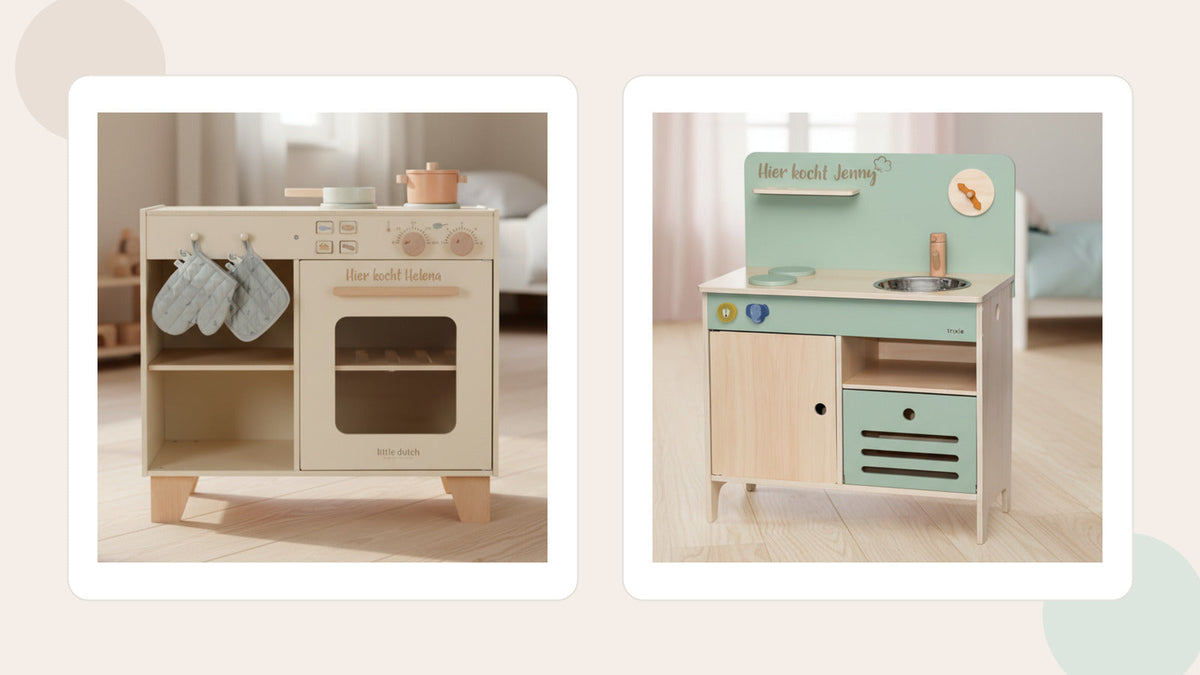
| Little Dutch Limited Edition | approx. 57 × 60 × 34 cm | from 3 years | you are looking for a compact kitchen with accessories and optional engraving |
| Trixie play kitchen | approx. 60 × 31 × 75 cm | from 3 years | the oven, sink, clock, and name engraving are important |
| JaBaDaBaDo White | approx. 30 × 55 × 80 cm | from 3 years | you prefer a taller, simple model without personalization |
Why a play kitchen is more than decoration
In role-playing games, children pick up on familiar everyday situations: they cook, serve, shop, or distribute tasks. The German Federal Institute for Public Health describes role-playing as a way to playfully understand the adult world, its tasks, and roles. At the same time, the specialist information emphasizes that an outfit does not have to be complete – imagination often arises precisely where objects are reinterpreted. More about role-playing in children.
A good play kitchen therefore provides a reliable framework without prescribing every detail. Knobs, doors, pots, and food invite action. Whether it becomes a restaurant, bakery, family kitchen, or shop is up to the child. That is exactly why an manageable, easy-to-combine set is often more practical for everyday use than as many accessories as possible at once.
The six most important selection criteria
1. Age recommendation and developmental stage
The three main models compared are offered from three years. This is not a blanket start date for every play kitchen: The information from the specific manufacturer, included small parts, and the individual developmental stage are decisive. For younger siblings in the household, accessories should consistently remain out of their reach if they are not suitable for them.
2. Footprint plus movement space
Do not measure only the width of the kitchen. Doors and oven flaps need space to open, and a child should be able to stand, squat, and turn around comfortably in front of the kitchen. When set up in the living room or hallway, the depth is often more important than the height. Marking the floor with painter's tape makes the future footprint surprisingly visible before purchase.
3. Working height instead of just total height
The total height says little about how comfortably a child plays at the stove. Therefore, check on the product page or using the images where the worktop, knobs, and handles are located. The child should be able to easily reach the central play elements without constantly standing on tiptoe. For siblings, a medium size can make more sense than a perfect height for only one child.
4. Delivery contents and expandability
“Play kitchen” does not automatically mean that food, dishes, and cooking utensils are included. The Little Dutch kitchen comes with two pans or pots, an oven mitt, and a potholder; JaBaDaBaDo includes two pots. Trixie focuses primarily on the kitchen, oven, sink, stove burners, and clock. Therefore, always compare the binding delivery contents before buying accessories twice.
5. Personalization as a gift decision
A name engraving makes a play kitchen more personal and can be a nice gift idea for a birthday or Christmas. It is particularly useful if the model is intended to stay in the child's room for a long time. Important: Carefully check the spelling and clarify before ordering which return or cancellation rules apply to individually made goods. Those who want maximum flexibility choose the unpersonalized version.
6. Safety, assembly, and condition
Pay attention to a stable setup, doors that close cleanly, undamaged edges, as well as the safety and assembly instructions. The German Federal Institute for Public Health recommends selecting toys suitable for age and developmental stage and regularly checking for breakages, splintered wood, or detached small parts. Information on safe toy purchasing. The CE marking explains the EU Commission as a manufacturer's declaration that the relevant EU requirements have been met; it still does not replace the observance of warning notices and age indications. Information from the EU Commission on CE marking.
Which play kitchen suits which need?
For little space: Little Dutch Limited Edition
At around 57 × 60 × 34 cm, this model remains comparatively compact and comes with basic accessories. The kitchen is suitable if you are looking for a complete play base but want to limit accessories initially. A name engraving is optionally available.
For many everyday scenarios: Trixie
The oven, sink, two stove burners, and clock provide several clear play ideas. The model suits families whose child likes to reenact routines: preparing ingredients, cooking, baking, washing up, serving. The optional engraving also makes it a personal, larger gift.
For a bright, simple children's room: JaBaDaBaDo
The white kitchen is around 80 cm tall and comes with two pots. It suits if you are looking for a straightforward model without personalization. Due to the currently small stock, it is more of a concrete choice than a permanent standard recommendation.
Rule of thumb: First choose the footprint and age, then the delivery contents and play interests. Color and personalization come after. This prevents a beautiful kitchen from being too large, too high, or unnecessarily fully equipped in everyday use.
Currently available models and sensible additions
All following products were active, publicly accessible, and available in at least one variant during the editorial review. Stocks may change.


Compare Play Kitchens & Accessories
Typical Buying Mistakes – and How to Avoid Them
- Deciding Only by the Photo: Measure the footprint and plan space for doors and playing siblings.
- Assuming Accessories Are Included: Check the delivery contents. Product images and decorations may show more than is included.
- Buying Too Early: The age indication of the specific model takes precedence over the gift idea. Caution is more important than anticipation when it comes to small parts.
- Adding Everything at Once: Start with a few play objects. New accessories can be added later to suit the child's interests.
- Sending Personalization Without Checking: Check the name, capitalization, and desired design before ordering.
- Forgetting Care and Inspection: Regularly check wooden toys for loose parts, splinters, or damaged connections, and clean them according to the manufacturer's instructions.
If you want to learn more generally about materials and play value, our guide to high-quality wooden toys will help. For the concrete order, the Play Kitchens and Accessories Collection leads to the currently available variants.
Conclusion: First Space and Play Style, Then Design
The right wooden play kitchen is not automatically the largest or most comprehensive model. For small spaces, the compact Little Dutch kitchen can be the most harmonious choice. Trixie is convincing if various everyday scenarios and a name engraving are desired. JaBaDaBaDo suits a bright, simple children's room and does without personalization. Accessories should enable a new play routine – such as cutting, serving, or washing up – instead of just increasing the number of parts.
Frequently Asked Questions About Choosing a Wooden Play Kitchen
From What Age Is a Play Kitchen Suitable?
This depends on the specific model. The main models compared here are intended from three years according to the manufacturer. Always pay attention to the product information, warning notices, and your child's developmental stage.
How Big Should a Play Kitchen Be?
It should fit the available footprint, and its most important elements should be within reach for the child. In addition, you need space in front of doors and flaps. A floor marking before purchase helps with the assessment.
Is a Wooden Play Kitchen Better Than One Made of Plastic?
Not necessarily. Material, workmanship, construction, care, and specific safety instructions are more important than a single material label. Wood often feels calm and stable, but it can also be damaged and must be checked.
What Accessories Does a Children's Kitchen Really Need?
For the start, a few parts that enable actions are sufficient: a pot, a pan, a spoon, and some play food. Cutting fruit or a coffee machine are sensible later additions if they suit the play interest.
Is a Personalized Play Kitchen Worth It?
As a long-term birthday or Christmas gift, a name engraving can have a special sentimental value. Check the spelling and conditions for individually made products. For passing on or resale, an unpersonalized kitchen is more flexible.
Where Should the Play Kitchen Be Placed?
Many younger children like to play within sight of a caregiver. A place in the living or dining area can therefore work better than a secluded corner in the children's room. A stable stand and clear paths are important.
How to keep the play kitchen interesting for a long time?
Don't constantly change all the accessories. A new theme – breakfast café, bakery, market, or restaurant – and a few matching items are often enough to inspire new stories.
