







Children's tableware for toddlers: Which set is right for you?
Direct answer: For the first independent meals, a lightweight, break-resistant set with a plate, bowl, cup, and spoon is usually sufficient. If you want to buy as little as possible separately, choose a complete 6-piece set with cutlery. Porcelain feels like the family dishes, but it is heavier and can break; it is therefore more suitable for children who are already sitting more securely at the table and handling dishes consciously. The deciding factors are not the design or the number of pieces alone, but the material, stability, care instructions, and the question of which pieces you really use every day.
Children's dishes look uncomplicated at first glance: a small plate, a bowl, maybe a cup. In everyday life, however, the differences quickly become apparent. One set slips while spooning, another is missing exactly the right cutlery, and a third may be dishwasher-safe but not microwave-safe.
This guide helps you make a concrete selection. It compares lightweight plastic sets, porcelain, different set sizes, and useful additions. The goal is not to declare one material the winner across the board, but to find the right children's dishes for your family's everyday life.
Choosing children's dishes: the quick decision
| Your needs | Sensible choice | What to look for |
|---|---|---|
| First independent meals | lightweight, break-resistant 4-piece set | non-slip underside, small spoon |
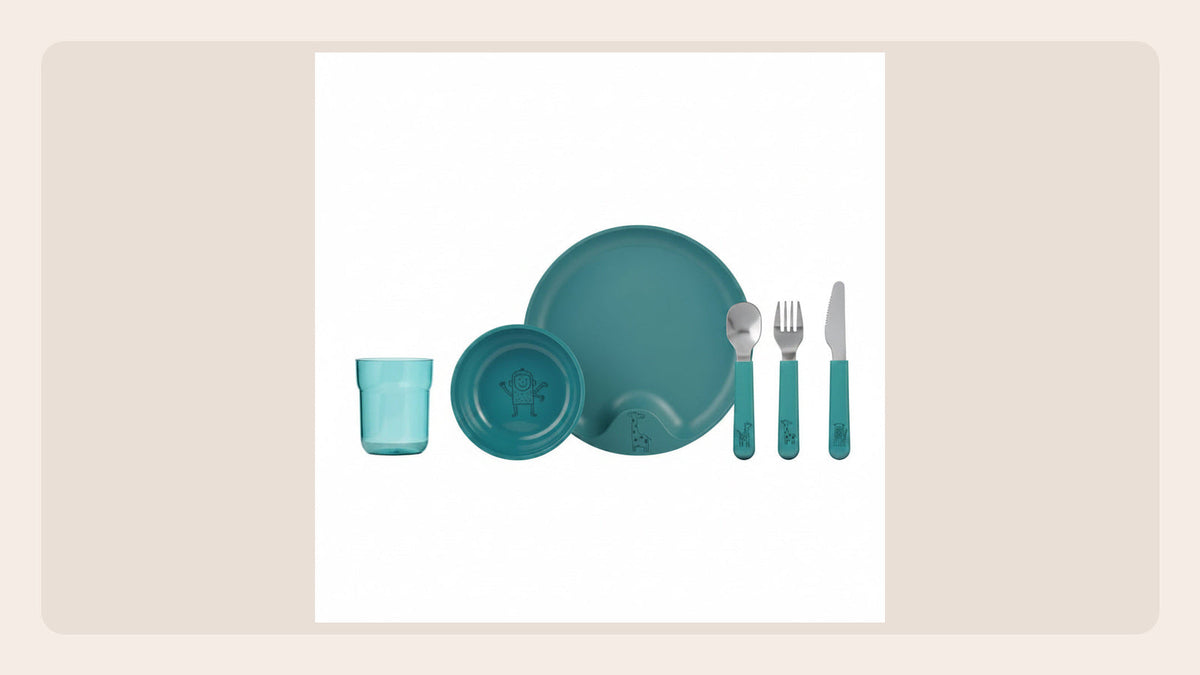
| Everything in one purchase | 6-piece set with plate, bowl, cup, and cutlery | whether all pieces are really age-appropriate for use |
| Small kitchen | stackable 3-piece set | cutlery may need to be added |
| Eating like the grown-ups | Porcelain with non-slip silicone rings | breakage risk and manufacturer's age recommendation |
| Supplement existing dishes | separate children's cutlery or training cup | handle size, care, and actual need |
Which material is right for toddlers?
Food-contact materials such as plates, cups, and cutlery must be manufactured in the EU so that they do not release health-threatening quantities of substances into food under normal or foreseeable conditions of use. This applies to plastic as well as glass, metal, or ceramics. The European Commission's information on food contact materials provides a good overview.
Lightweight plastic: suitable for everyday use and break-resistant
Plastic sets are lightweight, easy for small hands to lift, and usually withstand a typical fall from the table better than porcelain. Differences lie in the material composition and usage instructions. "Dishwasher-safe" does not automatically mean "microwave-safe". Therefore, check the specifications of each individual model.
Terms such as bio-based plastic indicate the raw material base used, but do not automatically make a product compostable. For the purchasing decision, specific care and temperature instructions are more helpful than a single buzzword.
Porcelain: a familiar eating experience, but not break-proof
Porcelain is shape-stable, flavor-neutral, and resembles adult dishes. The additional weight can help it stand securely. At the same time, porcelain can break if dropped or bumped. The Little Mateys set selected here is recommended by the manufacturer from age three and features removable silicone rings for greater stability.
Stainless steel and silicone: often useful additions
Stainless steel is found mainly in children's cutlery. Silicone is often used for handles, seals, or non-slip rings. Neither replaces a complete set of dishes, but can complement exactly the function that is missing in everyday life.
How many pieces does a children's dish set need?
The best number of pieces depends on your daily routine:
- 3-piece: plate, bowl, and cup – compact, but without cutlery.
- 4-piece: usually plate, bowl, cup, and spoon – a good start for first independent meals.
- 6-piece: additionally fork and knife – practical if you are looking for a complete set.
More pieces are not automatically better. If your child initially only uses a bowl and spoon, a small set may be more practical. An existing favorite dish can later be specifically supplemented with children's cutlery or a matching training cup.
Five selection criteria that matter in everyday life
1. Stability
A non-slip ring helps if a child is still spooning with a lot of force. However, it does not replace supervision and does not make dishes tip-proof. Also check whether the ring is removable and needs to be cleaned separately.
2. The right size
Small plates look child-friendly but should still offer enough space for a typical family meal. A bowl is particularly practical for porridge, muesli, soups, or snacks. A cup that is too large quickly becomes heavy and unwieldy.
3. Dishwasher and microwave
Dishwasher-safe dishes save time in everyday family life. For the microwave: Only use if the specific product is expressly designed for it. According to the stored product data, the Mepal set allows the plate and bowl to be used in the microwave; the separate Mepal training cup, however, is not microwave-safe.
4. Age and development
Manufacturer specifications help provide guidance, but do not replace an assessment of your own child. The 4-piece Lässig set and the selected children's cutlery are rated from twelve months; the porcelain set from age three. A training cup can be useful even earlier, if it suits the child's individual drinking development.
5. Replacement and supplementation
A complete set is convenient. Individual additions are more flexible if plates and bowls are already available. Before purchasing, consider whether you really need a new complete set or just a cup or cutlery.
Six available solutions compared
All the following products were active, publicly accessible, and in stock in at least one variant during the review. The information describes the respective sensible use – not a general ranking.


Avoid typical bad purchases
- Decide based on design alone: A favorite design helps little if the set slips or the required pieces are missing.
- Assume microwave suitability: It only applies if it is expressly stated for the specific piece.
- Choose porcelain too early: A breakable set is only suitable when both the child and the eating situation are ready for it.
- Buy too many pieces: If you already have cups and cutlery, a compact set is often better.
- Ignore damage: Cracked, chipped, or heavily scratched pieces must be replaced.
Priorities for meals on the go are different from those at home. If you are also looking for a solution for daycare, the guide Lunchbox for daycare: Size, compartments, and material helps. This keeps the search intentions clearly separated: Here it is about dishes at the table, there about transport and storage.
Conclusion: The best set is the most suitable one
For many families, a lightweight 4- or 6-piece set is the most practical start. A 4-piece set covers the most important pieces, while a 6-piece set additionally offers complete cutlery. Porcelain is a good later option when the child handles dishes more securely and the feel of the family dishes is desired.
The logical next step: First check which pieces are missing. Then decide between a lightweight everyday set and porcelain, compare the care instructions, and only then choose the color or design.
Frequently asked questions about children's dishes
Which children's dishes are suitable for beginners?
Usually, a lightweight, break-resistant set with a plate, bowl, cup, and spoon is suitable. A non-slip underside can make first independent eating attempts easier.
Are four or six pieces better?
Four pieces are sufficient if initially mainly the spoon, plate, bowl, and cup are used. Six pieces are sensible if the fork and knife are to be included directly.
Is porcelain suitable for toddlers?
Yes, if the manufacturer's age recommendation is met and the child can already handle dishes consciously. Porcelain is heavier and can break; damaged pieces must not be reused.
Can children's dishes go in the microwave?
Only if the manufacturer expressly states it for the specific piece. Within a set, different instructions may apply to the plate, bowl, cup, or cutlery.
What does a non-slip ring mean?
It increases grip on smooth table surfaces. However, it does not make the dishes tip-proof and must be removed for cleaning depending on the model.
Does a child need their own cutlery?
Children's cutlery is smaller and often easier to grip. A separate set is particularly worthwhile if suitable dishes are already available.
When should children's dishes be replaced?
If pieces show cracks, chips, severe deformations, or deep scratches. Also follow the manufacturer's care and usage instructions.
